

What does the CultureSource Staff Think about AI?
An exercise in technology, policy, and communication
How is your staff already using AI? This question came up at CultureSource’s most recent Spring Biannual Member Meeting, where we hosted a panel about Arts, Technology, and the Rise of AI. (Read our Event Roundup for a full summary).
As a part of this panel, Koven Smith gave organizations a practical first step when trying to practically approach the use of AI in the workplace: start by asking staff how they are already using AI.
At CultureSource, we decided that we wanted to follow Koven’s advice for three reasons:
- To understand how our staff is already using AI in their work, and what reservations they might have about it.
- To collaboratively create a set of expectations around the use of AI in our workplace.
- To show our members how they can use an exercise like this at their organizations.
We did this by creating an anonymous survey of four questions. We told our staff that that their answers would be published in a web story anonymously, and encouraged them to share their honest thoughts and hot takes. The questions and their responses are below.
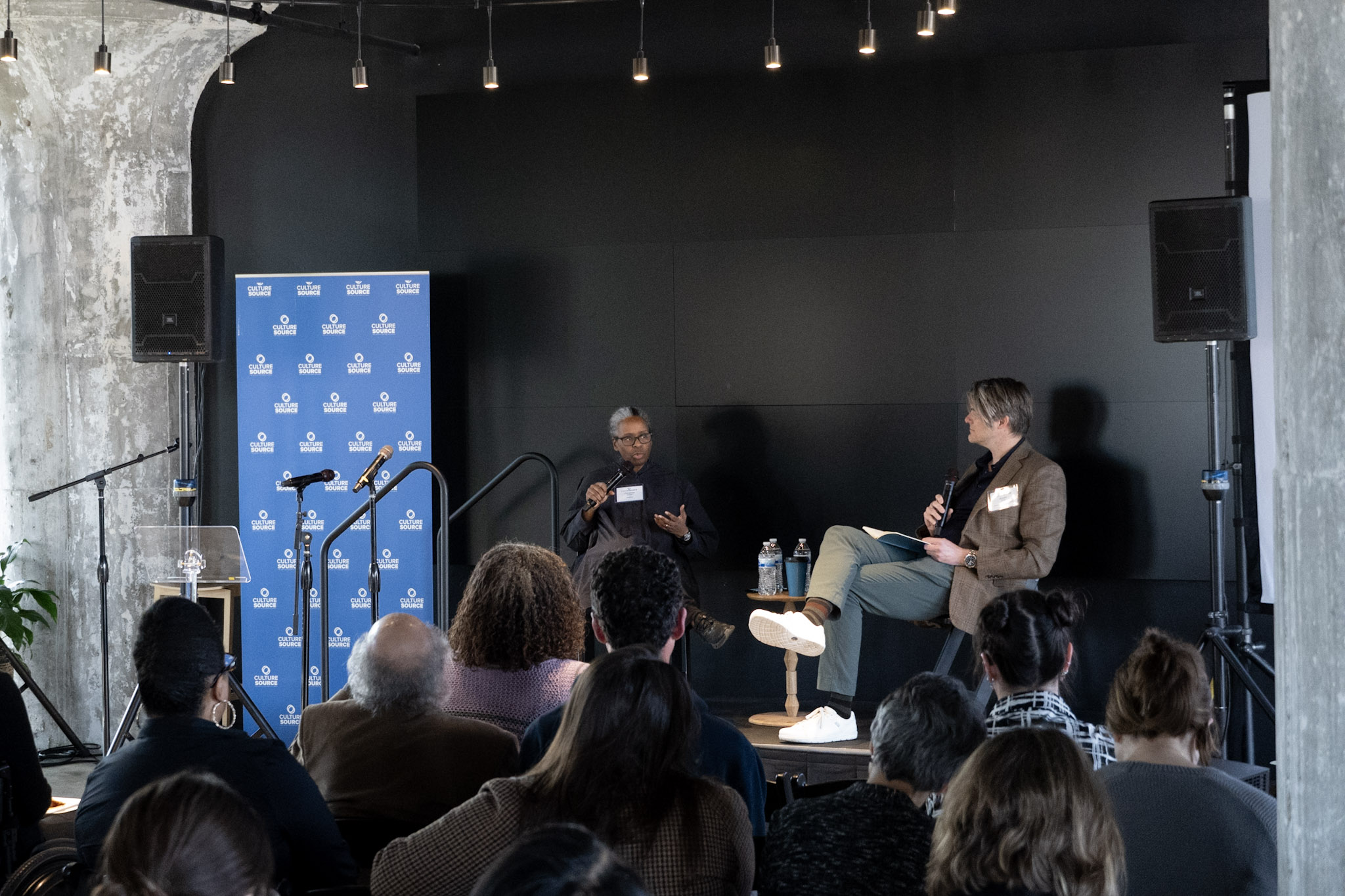
Cezanne Charles: Artist, researcher, and co-founder of Detroit studio rootoftwo
Koven Smith: Consultant and former arts program director at Knight Foundation
Jump to section:
- AI in the workplace is…
- How are you using AI in your work right now, or why aren’t you?
- What’s one thing you think AI should never do at CultureSource, what’s one thing you wish it could help with right now?
- Do you have any other thoughts about AI that you would like to share with our members through this web story?
- So, What Now?
1.) AI in the workplace is...
“complicated”
“necessary”
“daunting”
“helpful.”
“bound to only increase.”
“both useful and frustrating”
“A tool like Google search, Word, CRM, etc”
“unavoidable, helpful yet misleading, a helping hand.”
“A tool that should never displace the humanity within the work — only amplify it.”
“Necessary at this point. In order to stay current and with the times, one needs to learn at least a little bit about AI whether they use it daily or not”
“scary and unnecessary. Especially in the arts, it worries me that we will lose the human spark that makes the arts so pivotal to the human experience.”
2.) How are you using AI in your work right now, or why aren’t you?
(Percentages taken from mentions in long-form responses)
“To support clarity, correctness, and polish in writing.”
x6
“I’m only using it for summarizing and capturing meeting notes at the moment…”
x3
“Right now I’m using AI as an editing partner and a systems builder…”
x2
“I do not use AI in my work or personal life and I actively attempt to turn off any default AI tools if I am able…”
x3
Read our Staff's Full Responses to this Question
“It’s helping me write policies and guides for the organization and think through potential scenarios for when these policies are in use. It isn’t making decisions for me, but helping me think through pain points before rolling out policies to the team.
I can let AI know how team members use the tools and services we have, the strengths and limitations of their knowledge, and how to design language and policies around the least informed competent user. That way policies and guidelines are considered across the broad spectrum of knowledge and ability across the team, rather than just how I know and understand our tools, services, and our work. Oddly enough, it’s helping me check my own assumptions by asking it questions and helping me think through solutions to problems in real time while still maintaining best practices.”
“To support clarity, correctness, and polish in writing.”
“Right now I’m using AI as an editing partner and a systems builder. It helps me move faster on things that used to take hours, like structuring documents, synthesizing information, and turning transcripts into usable notes. I’ve also used it to build tools, like a dynamic analytics dashboard that pulls in real-time data.
At the same time, I’m still figuring out where it actually adds value versus where it just adds noise. I’m less interested in using AI to do more for the sake of it, and more interested in using it to work more clearly, build better systems, and create space for the parts of the job that require judgment, context, and care.
I’m also not interested in uses of AI that replace the work of artists. The generative outputs often fall flat, devaluing the creative work of the human hand and mind.”
“I tend to avoid using AI in my work when I can. I have worries about privacy, the environment, integrity, etc. I also haven’t found that AI has been particularly useful for the tasks that I complete regularly, as it tends to not work well with the way that I process information.”
“I’m only using it for summarizing and capturing meeting notes at the moment, although I may investigate other ways it might help make some of my tasks easier/less time consuming, for research, etc. I’m not opposed to using it for more things but I need to do some research”
“In DuckDuckGo and ChatGPT, I mostly use AI as an internet search assistant, though I know AI third-party applications are also working in the background of a lot of software and apps I use daily”
“I mostly use AI in my work to help me think of words, create document outlines, pull out and organize topics and themes from my notes, and to suggest formula automations in spreadsheets.”
“I use it as a copy editor, as a red team or devils advocate to poke holes at my ideas and plans, and as a chief of staff to prep for meetings, organize my week, and sort priorities.”
“Limited use other than what’s integrated in tools we use.”
“I am using AI to help me draft documents and simplify external communication.”
3.) What’s one thing you think AI should never do at CultureSource, what’s one thing you wish it could help with right now?
AI Should Never:
(Percentages taken from mentions in long-form responses)
I Wish AI Could…
help with some automation in our CRM system…
…simplify repetitive processes, freeing energy for the work that truly matters.
…solve its own sustainability issues, both on energy consumption and negative impacts on human labor.
…help with reporting and research.
x3
I’m not sure if I have a pressing issue that I wish it could help with right now….
…book venues and catering.
Read our Staff's Full Responses to this Question
“It should never replace human judgement, especially when considering topics that may be emotional or have grey areas. I also don’t believe AI should be used to create outward-facing assets, creative, or writing. For example, it shouldn’t be used to generate an an instagram post or the final caption for it. Anything that goes out to our members should be intentionally created.
I wish that AI could help with some automation in our CRM system, as there are many aspects of it that currently require manual input, but I would also want to be sure there aren’t issues with privacy and accuracy when handling that data.”
“I don’t think CultureSource should ever look to AI to make decisions (especially when concerning people, art, or strategy), but I do think we should use it more to support the documentation of those decisions. Example: I would hate to see AI used in making decisions around selecting grantees, but I would love to see it used more to support the structure and organization of documenting the results/progress/process.”
“It should never make unilateral decisions for us (hiring decisions, funding decisions, etc.). I’m not sure if I have a pressing issue that I wish it could help with right now. I think there’s still a lot I don’t know about AI in the workplace so it’s hard for me to identify the gaps that AI could help us fill.”
“It should never evaluate or select applicants for jobs or grants, substitute for the storytelling of lived experience, or stand in for genuine human connection and outreach.In regards to its help, it can simplify repetitive processes, freeing energy for the work that truly matters.”
“Don’t do: AI should never replace creativity. The human judgment, relationships, and care at the center of our work.
Do: Solve its own sustainability issues, both on energy consumption and negative impacts on human labor.”
“It should never replace a person, and should never present itself as a person if/when we use it. I wish it could help with reporting and research. (It probably can help already, but I haven’t investigated yet.)”
“It should never automate direct communications with members or our broader community – our relationships are not widgets! I wish it could book venues and catering.”
“It should never fully eliminate the need for staff to speak with our members. I wish it could do fully automated—start to finish—grant reporting for us.”
“Never – personal or financial data. Wish – efficiencies in reporting”
“I don’t believe AI should be used to review grants. People put a lot of effort into their applications, and they deserve to be reviewed by humans.”
4.) Do you have any other thoughts about AI that you would like to share with our members through this web story?
“I was really anti AI for a while for the obvious ethical/privacy and environmental reasons. But then I started using it to help me think through my ideas while writing and I found it to be a really helpful tool. I’m not asking AI to write things FOR me, but rather help me get to the core of an idea that I have and how to best articulate it…
Read More
I’m very cynical about the growth of AI and all the data centers that are causing REAL harm to communities, but at this point we’ve opened pandora’s box. There are ALWAYS problems with the things that are supposed to do good in the world. Look at political policies that were supposed to solve a problem that ended up creating entirely new issues (13th amendment anyone??). Or medications that were created to address real health issues and then got co-opted for something else entirely (opioids for chronic pain, GLP-1’s for diabetes, etc.). Nothing is perfect because humans aren’t perfect therefore the things we create aren’t perfect. This is how I ultimately feel about AI. It will never be a perfect or fully ethical tool, so one might as well learn a little about it because it’s here whether we want it to be or are ready for it or not.
Last thing I’ll say, and a prime example of the last sentence I wrote, is that in the film Hidden Figures, Dorothy Vaughan at NASA saw the IBM computer getting installed there, which means that the manual calculation work done by this department of black women (during segregation, no less) would be obsolete with a computer that could do calculations in milliseconds. Dorothy then learned about computer science and how to run the IBM machine and taught her whole department, so that when the time came they would have the skills needed to continue their work at NASA and not become obsolete because of this new technology.”
“I do have many concerns about the use of AI, like the impact it has on the environment, policy, jobs, privacy, and concerns around consenting or opting-in to training data. I think parts of the rollout of these products has been irresponsible, and I have worries about how the widespread adoption of AI will play into the growing literacy crisis. I can see AI being an extremely useful tools in scientific and experimental models, but the way it is now I don’t generally think it should be a widely-used consumer product…
Read More
In terms of my own work, I was always taught in my creative training that drafting, sketching, iterating, and thinking is a process of discovery and understanding. I was taught to make the ugly, imperfect version of something first, to not get stuck on perfection or speed, because some of the greatest learning happens in that process of mistakes and iteration. I feel like a lot of the advertised uses of AI cut out that process entirely.”
“In Outgrowing Modernity by Vanessa Machado de Oliveira the author challenges the notion that there is anything artificial about AI…after all all of the components and inputs are natural (from this earth) and human. We spend a lot of time pretending to have separation from things, especially those things we don’t like, but its all very entangled. Whatever your current stance and concerns with the tool remember to be compassionate and hold things lightly whichever side you find yourself on today.”
So, What Now?
These responses show a breadth of different experiences and opinions on the use of AI in the workplace, and will help us guide our thinking on AI use going forward. This may spark a conversation that could formalize a policy around AI, but for now we have created an AI Use Statement that focuses on adaptability, collaboration, and personal autonomy:
“CultureSource is actively and thoughtfully exploring the use of AI as part of our day-to-day work. While we do not yet have a formal policy in place, our team is encouraged to approach these tools with care, transparency, and curiosity. We use AI primarily to support and augment our workflows—helping to generate ideas, streamline processes, and serve as a co-thinking partner—rather than to replace human judgment or creativity. As a small team, we have the flexibility to experiment in real time, openly sharing how we are using these tools and reflecting together on their impact. This ongoing, collaborative approach allows us to test new technologies responsibly while building the foundation for a values-aligned AI policy in the future.”